Last updated 2026-08-18
TL;DR
Alabama does not issue a state HERS rater license. The credential you need is RESNET certification as a Home Energy Rating System Rater, earned through an accredited Rating Provider. First-year costs run $1,500 to $3,500 if you rent equipment, more if you buy a blower door new. Most candidates finish training and testing in four to eight weeks.
Do you need a state license to be a HERS rater in Alabama?
No. Alabama does not have a state-issued HERS rater license. There is no application to the Alabama Licensing Board for General Contractors, no fee to the Alabama Real Estate Commission, and no state exam for home energy ratings. The credential that matters is national: RESNET certification as a Home Energy Rating System Rater. [1]
RESNET, the Residential Energy Services Network, is the standards body that defines what a HERS rating is and who is qualified to produce one. Lenders, builders, and utility programs in Alabama accept HERS ratings only from raters certified under RESNET standards. [1] You earn that certification through an accredited Rating Provider, not through any Alabama state agency.
This surprises a lot of people coming from trades that do carry state licensing. Home energy auditing and HERS rating sit in a different regulatory lane here. You do not get a certificate on the wall from Montgomery. You get one from your Rating Provider after you meet RESNET's training, testing, and field mentorship requirements.
The picture is largely the same across the Southeast. See HERS rater license in Arkansas for a direct comparison.
What RESNET certification do you actually need?
RESNET recognizes two field credentials: Rater Trainee and certified Rater. A Trainee can produce ratings but only under a certified Rater's supervision. A certified Rater works independently and can mentor Trainees. [1]
To become a certified Rater you must:
1. Complete a RESNET-accredited training program covering building science, HERS software, and fieldwork protocol. 2. Pass the RESNET Rater written exam. 3. Complete the required supervised ratings (the current RESNET standard is five ratings filed under a certified Rater's supervision). [2] 4. Register with a RESNET-accredited Rating Provider, the organizational entity that files ratings to RESNET's national registry.
Every HERS rating filed in Alabama runs through a Rating Provider. You affiliate with one as an employee, contractor, or independent operator. Finding a Provider willing to onboard you is part of the early work. Talk to a few before you commit to training, because their supervision fees and software preferences vary.
RESNET publishes the certification rules in its Mortgage Industry National Home Energy Rating Standards (MINHERS), the document that controls all of this. [2]
How much does getting a HERS rater certification cost in Alabama?
Nobody publishes one tidy number, because the costs come from several sources priced independently. Here is an honest breakdown of what you spend in year one.
| Cost item | Typical range | Notes |
|---|---|---|
| RESNET Rater training (classroom or online) | $700 to $1,500 | Varies by provider and format |
| RESNET exam fee | $150 to $250 | Confirm current fee at resnet.us |
| Rating Provider affiliation / supervision fee | $0 to $500 | Some providers charge; others fold it into software fees |
| HERS rating software (first year) | $200 to $600 | REM/Rate and EnergyGauge are common choices |
| Blower door rental or purchase (if buying) | $1,200 to $4,500 | Renting per job is an option early on |
| Duct leakage tester | $800 to $2,500 | Also rentable |
| RESNET annual membership (Rater) | ~$200 | Confirm current fee at resnet.us [1] |
If you already own a blower door or can partner with someone who does, your cash outlay drops a lot. Buying gear from scratch, plan on $3,000 to $5,000 in total first-year spend before your first paid rating.
HERSPath has a bundle pairing the $179 RESNET enrollment with a blower-door kit for people at the very start. Use that or source pieces separately. The line items above are the same ones you pay either way.
Alabama has no state exam fee, no state application fee, and no state fingerprinting fee for HERS raters. [3] That is a real cost advantage over states that layer in an extra $200 to $500 in licensing overhead.
How long does it take to become a HERS rater in Alabama?
Most people are field-ready in four to twelve weeks, depending on how fast they schedule their supervised ratings.
The training itself, online or in a live classroom, runs three to five days of content. Some providers spread that over two weeks of part-time online modules. Others do an intensive five-day in-person course. [4] After training you sit the RESNET written exam. Scheduling varies by testing center, but two to three weeks is a typical wait if you are not near a major metro.
The supervised ratings are usually the real bottleneck. RESNET requires five supervised ratings before you can apply for full Rater status. [2] How fast you finish depends entirely on job volume in your market and how responsive your supervising Rater is. In a busy market like Huntsville or Birmingham, where new residential construction is active, five ratings might take three weeks. In a slower rural market, it could take two months.
Realistic timeline from "I'm signing up" to independent certified Rater: six weeks on the fast end, three to four months if scheduling is hard. Nobody should promise you faster.
What is Alabama's building energy code, and does it require HERS ratings?
Alabama adopted the International Energy Conservation Code (IECC) 2009 as its statewide residential energy code. [5] That is one of the older baselines in the country. The 2009 IECC does not use HERS ratings as a compliance path the way more recent code editions do.
So HERS ratings in Alabama are driven by market demand, not a code mandate. Builders chasing Energy Star certification, utility incentive programs, USDA Rural Development loan requirements, and buyers who want a documented efficiency score are the main drivers. [6] Alabama Power residential efficiency programs and TVA programs (which cover parts of northern Alabama) both reference energy ratings in their incentive structures. [7]
Some jurisdictions have adopted newer codes or locally enhanced requirements. Confirm with the specific jurisdiction you are working in. Broadly, though, you will not walk into most Alabama building departments and find them demanding a HERS index on every permit.
That code environment creates an opportunity. Raters who can explain the HERS index to builders and buyers, and tie ratings to real incentive dollars, build their own demand instead of waiting for a mandate. That sales skill matters more here than in states where ratings are already required.
Where do you find a RESNET-accredited Rating Provider in Alabama?
RESNET runs a public directory of accredited Rating Providers searchable by state. [1] Search for providers with active operations in Alabama. Some national providers work across many states remotely. Others are regional and prefer local affiliates.
When you contact providers, ask these questions:
- What is your supervision fee for trainees?
- What rating software does your organization use, and is training included?
- How do you handle the five required supervised ratings (do you assign them, or do I source jobs myself)?
- What is your ongoing per-rating fee after I'm certified?
The answers vary enough that a provider who is cheap on supervision might cost more per rating over time. Get the full picture before you commit.
Alabama raters often affiliate with providers headquartered in Georgia, Tennessee, or Florida. That is normal under RESNET's framework. The provider's physical location does not limit where you work.
For a full walkthrough from initial contact to filing your first rating, see how to start HERS rater in Alabama.
Is Alabama a good market for HERS raters right now?
Alabama's residential construction market has grown steadily. The U.S. Census Bureau's Building Permits Survey shows Alabama issuing roughly 20,000 to 25,000 new residential permits per year in recent years. [8] That volume creates a real base of potential ratings work.
Huntsville has seen big growth tied to aerospace and defense employment, and that market tends to attract buyers who value efficiency documentation. Birmingham's urban redevelopment and suburban growth also produce steady new construction. [8]
The catch is that Alabama's 2009 IECC base code does not force ratings, so the raters who succeed here are good at explaining value to builders. The rater who can show a builder how a HERS rating helps qualify buyers for FHA Energy Efficient Mortgages, or how it feeds Alabama Power's efficiency programs, earns repeat business. [7]
Competition varies by region. Northern Alabama (near Huntsville) has more established raters thanks to proximity to Tennessee Valley Authority programs. Central and southern Alabama have thinner coverage, which can mean less competition but also less buyer and builder awareness.
To compare the regulatory and market picture in a neighboring state, HERS rater license in Arkansas and HERS rater license in Colorado are worth a read.
What equipment do HERS raters in Alabama need to own or rent?
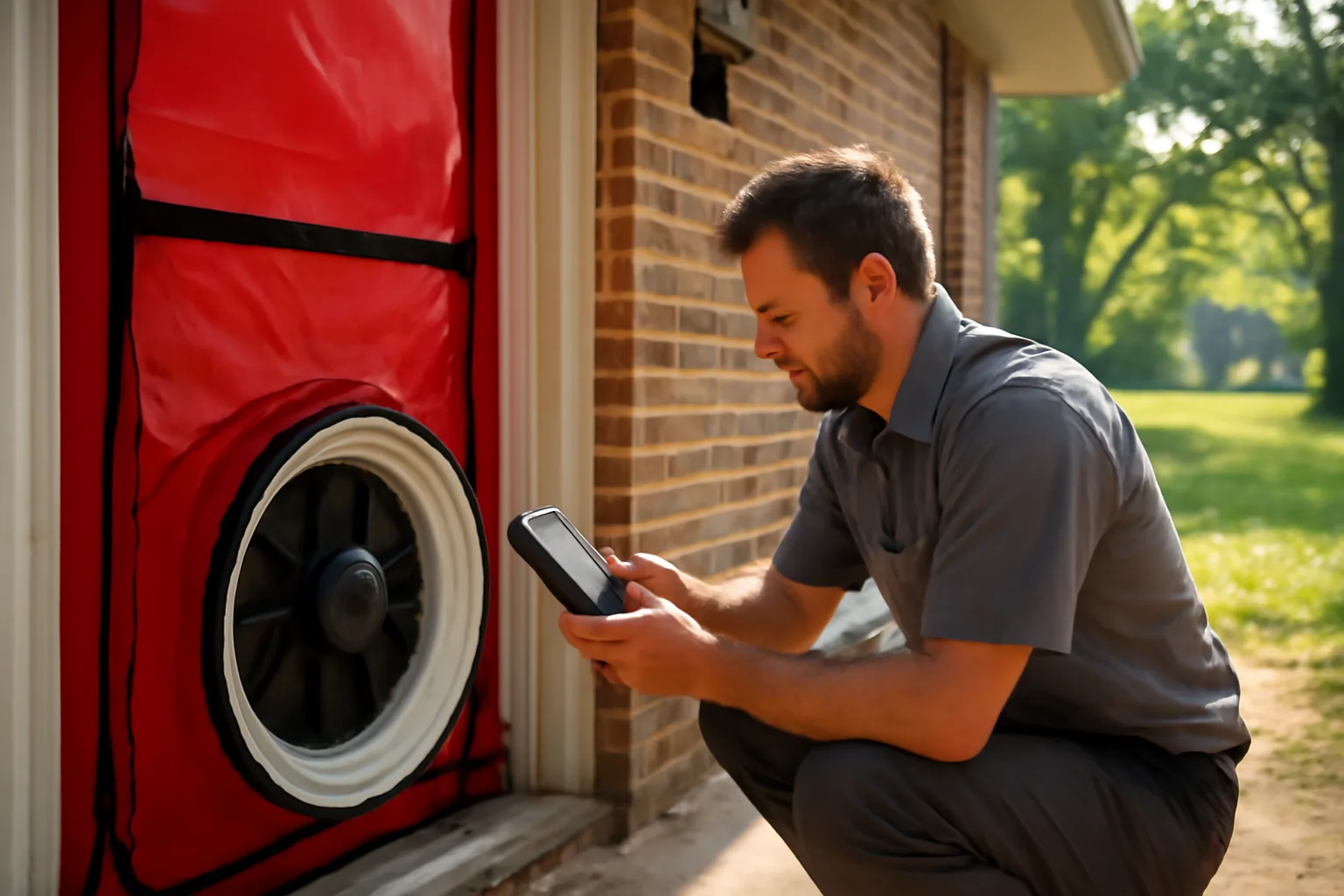
Two tools sit at the center of nearly every HERS rating: a blower door and a duct leakage tester (duct blaster). Both measure air leakage, one of the biggest inputs into the HERS index calculation.
A blower door measures whole-house air tightness. The common standard is the Minneapolis Blower Door, though other RESNET-approved equipment exists. New units cost roughly $3,000 to $4,500. [10] Used units in good shape run $1,500 to $2,500.
A duct blaster measures leakage in the duct system. New units run $1,200 to $2,500 depending on configuration. [10]
Early in your career, renting gear per job is a legitimate strategy. Rental runs run through some RESNET providers and regional energy efficiency organizations, and cost roughly $75 to $150 per day depending on equipment. Once you're doing two or more ratings per week, the ownership math tips in your favor fast.
Beyond that, you need a calibrated thermometer and humidity sensor, a combustion analyzer if you do combustion safety testing, and a reliable laptop running your HERS software. Plan on $200 to $500 for the smaller instruments.
Alabama's climate (hot-humid, mostly ASHRAE Climate Zone 2 and 3) means you spend a lot of time assessing cooling loads and moisture. Equipment that holds up in summer heat and humidity matters. Check that any used blower door you buy has been maintained and calibrated.
How does Alabama's climate zone affect HERS ratings?
Most of Alabama falls in ASHRAE Climate Zone 2 (hot-humid), with the northern tier moving into Zone 3 (mixed-humid). [11] This matters because the reference home in the HERS calculation is climate-zone-specific. A HERS 50 house in Birmingham is not the same physical building as a HERS 50 house in Minneapolis.
The practical implication for raters is that your Alabama field work leans heavily on:
- Cooling system efficiency (SEER ratings, sizing relative to Manual J)
- Duct location (ducts in conditioned vs. unconditioned space)
- Air barrier continuity and vapor management in humid conditions
- Attic insulation and radiant barrier use
The 2009 IECC reference home values in Alabama's code baseline are older. When you produce ratings for programs using more recent IECC editions (Energy Star references IECC 2015 or later for its reference design), you and your Rating Provider need to be clear on which reference year applies. [6]
Understanding climate zone specifics is part of your accredited training. Still, know going in that Alabama's heat-and-humidity profile means moisture management comes up constantly with builders.
Keeping your RESNET certification current: continuing education requirements
RESNET requires certified Raters to complete continuing education to keep their credentials. The current RESNET standard is six hours of continuing education per certification year. [2] Some Rating Providers require more.
Topics that count include updates to HERS standards, building science training, IECC code updates, and software training. RESNET publishes a list of approved CE providers and courses.
Renewal also requires you to keep your Rating Provider affiliation active and pay your annual RESNET member dues. If your Provider affiliation lapses, you cannot file ratings even if your individual credential is technically current.
One practical note. RESNET updates its MINHERS standards periodically, and some updates require raters to complete specific bridging training. [2] Subscribe to RESNET's newsletter or watch your Rating Provider's communications so a required course does not catch you off guard.
If you move or expand into neighboring states, your RESNET certification travels with you. No additional state licensing is required in Alabama, Arkansas, or most Southeast states. See how to start HERS rater in Arkansas if you are thinking about serving both markets.
Frequently asked questions
Do you need a license for HERS rater in Alabama?
No. Alabama does not issue a state HERS rater license. The required credential is RESNET certification, which is national, not state-specific. You earn it through an accredited Rating Provider by completing training, passing the RESNET written exam, and filing five supervised ratings. No application to any Alabama state agency is required.
How much does it cost to become a HERS rater in Alabama?
First-year costs typically range from $1,500 to $3,500 if you already own or can rent equipment. If you buy a blower door and duct blaster new, add another $3,000 to $7,000. Major cost buckets are training ($700 to $1,500), the RESNET exam ($150 to $250), software ($200 to $600), and annual RESNET dues (roughly $200). Alabama has no added state licensing fees.
How long does it take to become a HERS rater in Alabama?
Training takes three to five days. The written exam can be scheduled within two to three weeks after training. The five required supervised ratings take three weeks to two months depending on your local job market. Most candidates are independently certified within six weeks to four months from start. Nobody can guarantee faster.
Does Alabama require HERS ratings for new construction?
Not statewide. Alabama's residential energy code baseline is IECC 2009, which does not use HERS ratings as a compliance path. Individual jurisdictions may have adopted newer codes with different requirements. Ratings in Alabama are mostly driven by Energy Star certifications, utility incentive programs, and buyer demand, not a blanket state mandate.
Which Rating Provider should I choose as an Alabama HERS rater?
RESNET publishes a searchable directory of accredited Rating Providers at resnet.us. Look for providers active in Alabama or the Southeast. Ask each about supervision fees, per-rating fees after certification, software requirements, and how they handle the five required supervised ratings. The cheapest upfront option is not always the lowest total cost.
Can I do HERS ratings in Alabama if my Rating Provider is based in another state?
Yes. RESNET certification and Rating Provider affiliation are national, not state-bound. Many Alabama raters work under providers headquartered in Georgia, Tennessee, or Florida. There is no Alabama requirement that your provider or your supervising rater be physically located in the state.
What software do HERS raters in Alabama use?
The two most common HERS rating software packages are REM/Rate and EnergyGauge USA. Your Rating Provider may require one or the other, so confirm before you buy a license. Both run $200 to $600 per year for individual raters. Some providers bundle software access into their affiliation fee.
Do I need a blower door to be a HERS rater in Alabama?
Yes, blower door testing is required for a confirmed HERS rating under RESNET standards. You do not have to own one immediately. Renting per job ($75 to $150 per day) is common early in a rater's career. Once you're doing two or more ratings per week, buying your own pays off. New blower doors cost roughly $3,000 to $4,500.
Are there utility incentive programs in Alabama that use HERS ratings?
Yes. Alabama Power has residential efficiency programs, and TVA's programs apply to northern Alabama utilities. Both reference energy performance metrics that HERS ratings can document. Builders and buyers seeking FHA Energy Efficient Mortgages also use HERS scores. Confirm current program details directly with Alabama Power and TVA, since program terms change.
How many continuing education hours does a HERS rater need each year?
RESNET currently requires six hours of continuing education per certification year. Your Rating Provider may require additional hours. Topics include HERS standard updates, building science, IECC code changes, and software training. RESNET publishes a list of approved CE providers. Confirm current requirements at resnet.us because standards are updated periodically.
Is HERS rater work a viable full-time career in Alabama?
It can be, particularly in markets like Huntsville and Birmingham where new construction volume is steady. Alabama issues 20,000 to 25,000 new residential permits per year statewide. Raters who build relationships with active builders or combine HERS work with energy auditing for utility programs tend to find the most consistent volume. Rural markets are thinner.
What is the HERS index and why does it matter to Alabama home buyers?
The HERS index is a numeric score comparing a rated home to a reference home. A score of 100 matches the reference; lower is more efficient. A HERS 70 home uses roughly 30% less energy than the reference. Alabama buyers can use the score to compare homes, qualify for energy-efficient mortgages, and estimate utility costs before purchase.
Does Alabama have reciprocity with other states for HERS rater credentials?
The question doesn't really apply. RESNET certification is already national. There is no state-issued credential to reciprocate. A certified HERS rater can work in any state through their Rating Provider without added licensure. This is one reason HERS rater is a portable career compared to trades with state-specific licensing.
Sources
- RESNET, Residential Energy Services Network: RESNET certification as a Home Energy Rating System Rater is the national credential required to produce HERS ratings; no state license is required in Alabama
- RESNET, Mortgage Industry National Home Energy Rating Standards (MINHERS): RESNET requires five supervised ratings for Trainee-to-Rater upgrade and six hours of continuing education per certification year
- RESNET, Find a Rater / Training: RESNET-accredited training programs typically run three to five days of content in classroom or online format
- U.S. Department of Energy, Building Energy Codes Program, Residential Status: Alabama adopted IECC 2009 as its statewide residential energy code baseline
- U.S. EPA, ENERGY STAR Residential New Construction Program Requirements: Energy Star for Homes requires HERS ratings and references IECC 2015 for the reference home design in Climate Zones 2 and 3
- Tennessee Valley Authority, EnergyRight: TVA's EnergyRight program, which applies to northern Alabama utilities, references energy ratings in its residential incentive structure
- U.S. Census Bureau, Building Permits Survey, State-Level Data: Alabama issues approximately 20,000 to 25,000 new residential building permits per year
- The Energy Conservatory: New Minneapolis Blower Door systems cost approximately $3,000 to $4,500; duct testing equipment runs $1,200 to $2,500
- U.S. DOE Building Energy Codes Program, Residential Status: Most of Alabama is in ASHRAE Climate Zone 2 (hot-humid), with the northern tier in Climate Zone 3 (mixed-humid)