Last updated 2026-08-18
TL;DR
Getting credentialed as a HERS rater in California costs roughly $400 to $900 in total startup fees, covering RESNET membership, provider training, the proctored exam, and required field equipment. California does not issue a separate state HERS rater license, but Title 24 compliance work requires RESNET certification and enrollment with a California Energy Commission-approved rating provider.
Do you need a license to be a HERS rater in California?
No separate California state license exists for HERS raters. What California does require is certification under a RESNET-accredited rating provider that is also accepted by the California Energy Commission (CEC). The CEC's Title 24 Part 6 energy code governs residential energy compliance, and all HERS verification work must be performed by a certified rater enrolled with an approved Home Energy Rating System (HERS) provider. [1]
The CEC maintains a list of approved HERS providers, sometimes called rating organizations, on its website. You cannot simply pass the RESNET exam and start signing off on compliance documents in California. You must also register with one of those CEC-approved providers. That registration step is separate from RESNET membership and sometimes carries its own annual fee, though amounts vary by provider.
Your paper path looks like this: complete a RESNET-approved training program, pass the proctored exam, become a RESNET-registered rater, then affiliate with a CEC-approved rating organization that covers California. Only after all three steps can you legally sign HERS compliance forms in the state. [2]
How much does getting HERS rater certified cost in California?
The total varies more than most people expect, mostly because of field equipment costs that training programs either mention in passing or bury in footnotes. Here is a realistic breakdown.
RESNET membership and registration is the foundational fee. RESNET charges a one-time rater registration fee. As of the most recent published RESNET fee schedule, new rater registration runs roughly $150 to $200 for the exam and initial registration combined, though RESNET adjusts these periodically, so confirm the current figure directly at resnet.us before you budget. [3]
Training program tuition is usually the biggest line item. California-approved HERS training programs (offered by organizations like CHEERS, CalCERTS, and others) range from about $300 to $600 for the classroom or online portion. Some providers bundle the exam fee into the training cost. Others charge it separately. Ask your chosen provider explicitly whether the exam proctor fee is included before you pay.
The proctored exam itself, if not bundled, runs around $100 to $150. California raters must pass the RESNET Home Energy Rater exam, and some providers use third-party testing centers that add a separate facility fee.
Annual CEC-approved provider enrollment varies by organization. Some California rating organizations charge raters a per-rating fee rather than an annual flat fee. Others charge an annual affiliation fee in the $100 to $300 range. This is one of the most opaque parts of the cost picture, and it matters a lot if you're trying to project year-one expenses.
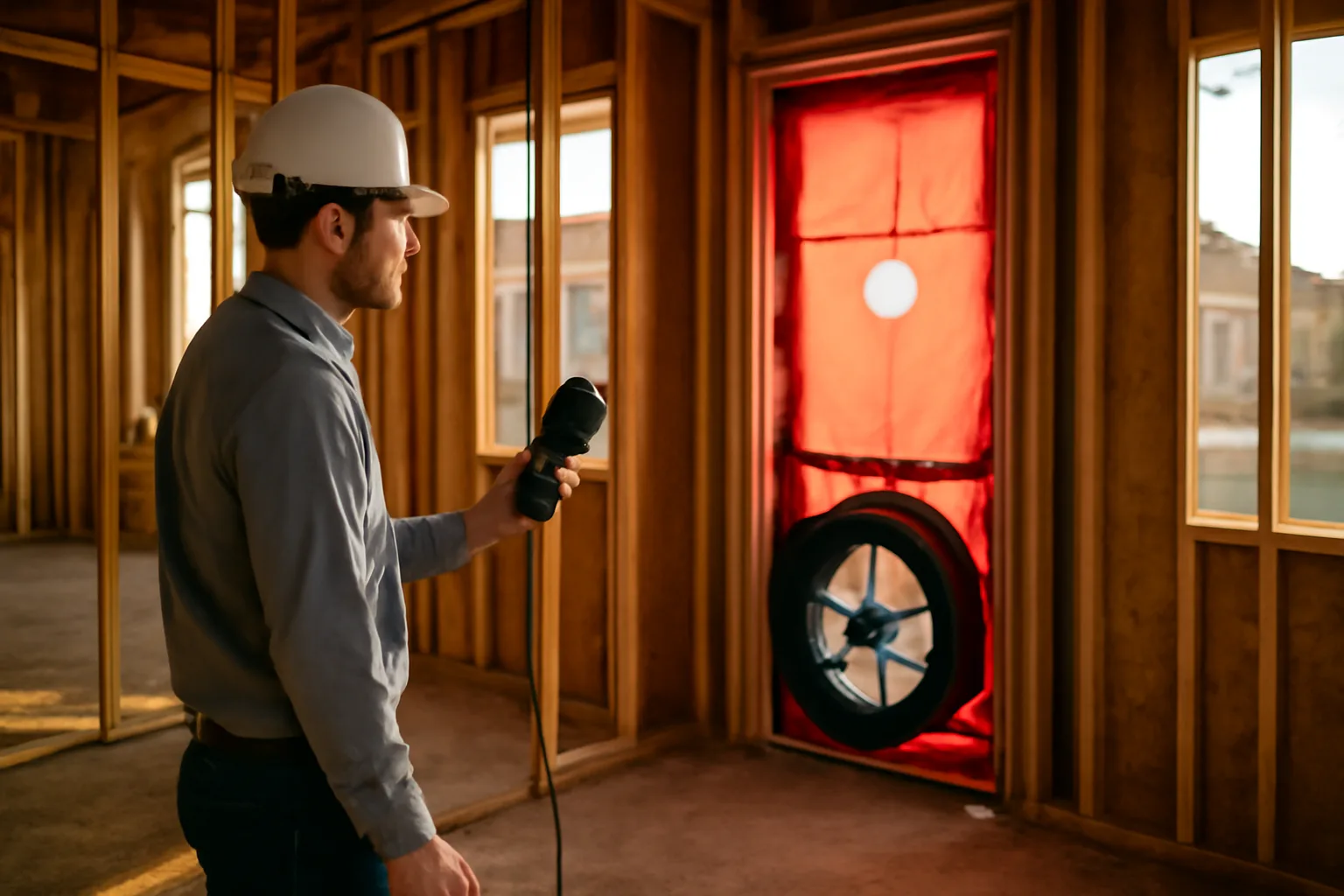
Field equipment is where California raters often get surprised. You will need a calibrated blower door (typically $1,500 to $3,500 for a new Minneapolis BlowerDoor or equivalent), a duct leakage tester, and a combustion safety testing kit at minimum. Used equipment can cut those costs a lot, but calibration records have to be current. Some training providers rent equipment for supervised field tests, which helps for the certification process itself, but you'll need your own gear for ongoing paid work.
All in, a California rater who already owns no equipment should expect to spend $400 to $900 on the training-and-credentialing side, then separately budget for equipment. Someone getting into this through a company that supplies the gear faces only the credentialing cost.
What does the RESNET exam fee cover and how does registration work?
RESNET is the national body that sets the standard for HERS ratings. Its published RESNET Mortgage Industry National Home Energy Rating Standards define what a HERS rating is, what a rater must do, and what minimum quality assurance oversight looks like. [4]
When you register as a RESNET-certified rater, you get a RESNET rater ID number, which California's CEC-approved providers require before they'll enroll you. The registration also activates your listing in the RESNET registry, which is publicly searchable and is how builders and code officials verify you are a legitimate rater. [8]
RESNET membership for individual raters is distinct from provider membership. You pay the rater registration fee. Your rating organization pays its own provider dues. The two fee streams don't overlap, and both are required for legal California work.
One thing worth knowing: RESNET certification has a continuing education requirement for renewal. Raters must complete quality assurance field reviews and periodic CE credits to stay active. California doesn't add a separate renewal fee on top of RESNET's structure, but if you let your RESNET registration lapse, you're also automatically non-compliant with the CEC's Title 24 verification requirements. [1]
Cost comparison: California HERS rater fees vs. nearby states
California's credentialing cost sits in the middle of the pack for western states. The training fees are similar to what you'd pay in Arizona or Colorado, but California's equipment requirements are somewhat stricter because Title 24 mandates duct leakage testing and, in many new-construction cases, verified mechanical ventilation. Your equipment kit in California typically needs to be more complete than what a rater might carry in a lower-code state.
| Fee Component | California (estimate) | Arizona (estimate) | Colorado (estimate) |
|---|---|---|---|
| RESNET exam + registration | $150, $200 | $150, $200 | $150, $200 |
| Training program | $300, $600 | $250, $500 | $300, $550 |
| CEC/state provider enrollment | $100, $300/yr | Similar provider fees | Similar provider fees |
| Blower door (new) | $1,500, $3,500 | $1,500, $3,500 | $1,500, $3,500 |
| Total (ex-equipment) | $550, $1,100 | $400, $700 | $450, $750 |
None of these ranges should be treated as fixed quotes. Training providers update tuition regularly, and RESNET has adjusted its fee schedule more than once in the past five years. The comparison is useful for relative sizing, not for writing a check.
For a deeper look at how other states structure their costs, see the HERS rater cost in Arizona and HERS rater cost in Colorado guides.
How long does it take to become a HERS rater in California?
The honest answer is 4 to 12 weeks from start to first signed rating, and the range is that wide for real reasons.
The classroom or online training portion usually runs 3 to 5 days of instruction, though some providers spread it over 2 to 3 weeks in evening sessions. That part is fast. The bottleneck is the supervised field work requirement: RESNET requires that new raters complete a set of supervised ratings before they can sign off independently, and getting those field dates on the calendar with your training provider can take 2 to 6 weeks depending on provider workload and your schedule.
After field work, your documentation goes to the rating organization for review. Once cleared, your RESNET registry listing goes active. Some providers move through this in days. Others have backlog. There is no published SLA for this step, so ask your specific provider what their typical turnaround is before you start.
If you're working toward a specific project deadline, start at least 10 weeks out. That gives you buffer for scheduling field days and for the provider review step. Rushing the field work portion is the most common reason people miss their target start date.
California does not add a separate state approval wait time beyond the CEC provider enrollment, which is generally administrative rather than a formal review process. Confirm the current enrollment timeline with your chosen provider.
Which California-approved HERS providers should you consider?
The CEC maintains the official list of approved HERS providers, and that list is the authoritative source. As of the most recent CEC updates, major California-active providers include CHEERS (California Home Energy Efficiency Rating Services), CalCERTS, and PG&E/CLTC affiliated programs, among others. [5]
Choosing a provider matters for more than just enrollment fees. Providers differ in how much field mentorship they offer new raters, how fast they process paperwork, and what software platforms they use for rating reports. California's Title 24 compliance reports use CEC-approved software (EnergyPro and others), and some providers are better integrated with specific software packages than others. If you already know you'll be working primarily in one climate zone or with one builder, ask potential providers which software their raters typically use.
Some providers also offer rater mentorship programs or have a bench of senior raters who can supervise your field tests quickly, which directly affects how fast you get through the supervised-rating requirement. That's a real operational difference, more than a marketing point.
HERSPath's prep material covers the national RESNET exam content and blower door fundamentals starting at $179 for the one-time study kit, which can help you go into provider training already familiar with the test structure. The CEC-approved provider training is not optional regardless of how you prepare.
What equipment do California HERS raters actually need?
California's Title 24 compliance requirements drive the equipment list more than RESNET's baseline standard does. For new residential construction, which is most of the volume market in California, raters typically need:
Blower door system. A calibrated fan, frame, and manometer. Minneapolis BlowerDoor Model 4 is common; the Retrotec Q4E is another option. Expect to spend $2,000 to $3,500 new, or $800 to $1,500 for a used but recently calibrated unit. Calibration must be traceable to a certified lab. [6]
Duct leakage tester. Duct Blaster or equivalent. California's Title 24 requires duct leakage testing on new construction systems, and this is a separate piece of equipment from the blower door. New units run $1,500 to $2,500. Used calibrated units can be found for $600 to $1,200.
Digital manometer. Often included with the blower door kit, but standalone units (Energy Conservatory DG-700 or similar) cost $400 to $600 if you need a second one.
Combustion safety kit. Not always required for new construction ratings but needed for existing home work and some California programs. A basic combustion analyzer runs $400 to $800.
Software license. EnergyPro and other CEC-approved Title 24 compliance tools charge annual licensing fees, typically $300 to $700 per year depending on the package.
The total equipment picture for a fully outfitted new California rater is $5,000 to $9,000 if buying everything new. Equipment rental for supervised field exams is available through some providers and is worth using while you're in training, but you'll need your own gear for production work.
How does California's Title 24 energy code affect what HERS raters do?
California's Title 24 Part 6, the Building Energy Efficiency Standards, is updated on a roughly two-year cycle. The 2022 Standards (effective January 1, 2023) expanded what requires HERS verification, including solar-ready requirements, heat pump water heater readiness, and expanded mechanical ventilation verification. [7]
The state energy code is administered by the California Energy Commission. According to the CEC, "HERS Raters conduct field verification and diagnostic testing to verify that newly constructed and existing residential buildings comply with the requirements of the Building Energy Efficiency Standards." [5] That quote comes directly from CEC guidance and is the clearest one-sentence description of the California-specific job scope.
This scope is broader than what HERS raters do in many other states. California raters are verifying duct leakage, envelope leakage, mechanical ventilation airflow, refrigerant charge, and in some cases solar PV system installation quality. Each verification category has its own measurement protocol and documentation requirement. That complexity is why California training programs tend to run longer and cost more than programs in states with simpler energy codes.
Because the 2022 Standards are relatively recent, some builders are still working through implementation details. Raters who understand the new solar-ready and heat pump provisions have a real market advantage right now. The CEC's Residential Compliance Manual is the authoritative reference document and is publicly available on the CEC website. [7]
What does a California HERS rater earn, and does the investment pay off?
Per-rating fees in California typically run $150 to $400 per site visit for standard new construction compliance work, depending on the rating complexity, the climate zone, and what's being verified. Raters working in high-volume new construction markets (Sacramento Valley, Inland Empire, Central Valley) can complete 3 to 5 ratings per day on tract housing, which makes the math work quickly.
Self-employed raters with a steady builder relationship can earn $60,000 to $120,000 per year in California, though nobody has published a peer-reviewed study on this specific population. The range comes from what's observable in job postings and in conversations within the RESNET rater community. Those figures are not guarantees.
The investment in certification, including the $400 to $900 in credentialing costs plus equipment, can realistically pay back within the first 2 to 3 months of steady work. The harder problem for most new raters is finding their first builder client, not recovering the credential cost.
For comparison on how the economics look in neighboring states, the HERS rater cost in Arizona and HERS rater cost in Hawaii pages cover regional market context.
What are the ongoing annual costs after you're certified?
Getting certified is a one-time project. Staying certified is a recurring expense. Here is what California raters typically pay each year after their first year.
RESNET quality assurance fees. RESNET requires that a percentage of each rater's work be reviewed by an accredited quality assurance provider (QAP). QA review fees are typically passed through to raters at a per-file or percentage-of-rating fee. Expect $20 to $50 per rating file reviewed, and RESNET's minimum QA sampling rate means at least 10% of your files get reviewed. [4]
Rating organization annual dues or per-rating fees. Depending on your California provider, this is either a flat annual enrollment fee ($100 to $300) or a per-rating charge that the provider takes off the top.
Software licensing. EnergyPro or equivalent Title 24 software, $300 to $700 per year.
Equipment calibration. Blower door and duct tester calibration is required periodically. Annual calibration runs $150 to $300 per instrument, more if you have to ship the equipment.
Continuing education. RESNET requires periodic CE credits. Some providers include CE in their annual membership. Others charge per course. Budget $100 to $300 per year.
All in, realistic annual operating costs for an established California HERS rater, excluding equipment depreciation, run $600 to $1,500 per year on the compliance and credentialing side alone, before any business expenses like insurance, travel, or software subscriptions.
For a fuller picture of how other states structure these ongoing costs, see the HERS rater cost in Florida and HERS rater cost in Georgia guides.
Where to start your California HERS rater application
Pick a CEC-approved HERS provider first. That organization guides your specific training path, schedules your supervised field tests, and handles your CEC enrollment paperwork. The CEC's approved providers list is the right starting point, not a generic Google search. [5]
Once you've chosen a provider, confirm with them directly: what is the current all-in tuition cost, is the exam fee included, how quickly can you schedule field test days, and what is the current enrollment timeline with the CEC. Those four questions, asked before you pay anything, will give you a realistic project plan.
If you want to get ahead on exam content before your formal training starts, HERSPath's study kit covers the RESNET exam blueprint and core blower door methodology. It's a useful head start, not a replacement for the required provider training.
For context on how the process and costs compare across the region, the HERS rater cost in Idaho and HERS rater cost in Colorado pages cover the Pacific West and Mountain West markets respectively. If you're deciding between California and a neighboring state for where to build your practice, those comparisons are worth reading before you commit.
You can start the process at /start.
Frequently asked questions
Do you need a license for HERS rater in California?
California does not issue a standalone HERS rater state license. To legally perform HERS verification under Title 24, you must be a RESNET-certified rater and enrolled with a California Energy Commission-approved rating organization. Both of those are required simultaneously. Skipping the CEC provider enrollment step means your compliance signatures are not valid on California permit documents, even if your RESNET certification is current.
How much does HERS rater certification cost in California total?
Budget $400 to $900 for the credentialing steps: RESNET registration ($150 to $200), provider training ($300 to $600), and CEC provider enrollment ($100 to $300 annually). Equipment is separate and runs $3,500 to $8,000 new for a full California kit. Some raters start by working under an established rater who supplies the equipment, which reduces day-one costs significantly.
How long does it take to become a HERS rater in California?
Typically 4 to 12 weeks from starting training to completing your first independent rating. Training itself takes 3 to 5 days. The supervised field work requirement and provider review process take most of the remaining time. Scheduling field test days is usually the real bottleneck, not the paperwork. Plan for 10 weeks if you have a hard project start date.
What training programs are approved for California HERS raters?
Training must be through a RESNET-accredited provider that is also accepted by the CEC. Major options operating in California include CHEERS and CalCERTS. The CEC's approved HERS providers list is the authoritative source and should be checked before enrolling in any program. Not all RESNET-accredited national training programs satisfy the CEC's specific requirements.
What equipment does a California HERS rater need to buy?
At minimum: a calibrated blower door system ($2,000 to $3,500 new), a duct leakage tester ($1,500 to $2,500 new), and a digital manometer. California's Title 24 also requires combustion safety testing for many existing-home ratings. A Title 24 software license (EnergyPro or equivalent) adds $300 to $700 per year. Used equipment with current calibration records is an acceptable and much cheaper alternative.
Can I perform HERS ratings in California with only a RESNET certification?
No. RESNET certification is necessary but not sufficient for California work. You also need to be affiliated with a California Energy Commission-approved HERS rating organization. That enrollment is a separate step with its own fee. Raters who skip this step cannot legally sign Title 24 HERS compliance documentation in the state, even if they have a valid RESNET rater ID.
How much do California HERS raters charge per rating?
Per-rating fees typically run $150 to $400 per site visit for standard new residential construction work in California. Complexity, climate zone, and the scope of verification required (duct leakage only vs. full HERS package) all affect the fee. Raters working in high-volume tract housing markets can complete multiple ratings per day, which changes the per-day economics considerably.
Does California's Title 24 energy code require HERS verification?
Yes. California's Building Energy Efficiency Standards (Title 24 Part 6) require HERS verification for new residential construction in most compliance scenarios. The 2022 Standards, effective January 1, 2023, expanded the scope of required HERS measures to include solar-ready provisions, mechanical ventilation verification, and heat pump water heater readiness checks. HERS verification is not optional for permit-compliant new residential work.
Are there annual renewal costs for California HERS raters?
Yes. Ongoing annual costs include RESNET quality assurance review fees ($20 to $50 per reviewed file), rating organization dues or per-rating fees, Title 24 software licensing ($300 to $700), equipment calibration ($150 to $300 per instrument), and continuing education. Total annual overhead typically runs $600 to $1,500 before business expenses. These costs are in addition to, not instead of, the initial certification costs.
Is the HERS rater exam hard to pass?
The RESNET Home Energy Rater exam covers building science fundamentals, energy modeling concepts, field testing protocols, and RESNET standards. Pass rates are not publicly published by RESNET, so no honest answer about difficulty is possible from data alone. Candidates who go through an accredited training program and review the RESNET Mortgage Industry National Home Energy Rating Standards before testing generally report being adequately prepared.
Can I use out-of-state HERS ratings for California projects?
No. California Title 24 compliance ratings must be performed by a rater enrolled with a CEC-approved California HERS provider, regardless of where the rater is based. A rater certified in another state can work on California projects, but they still must complete CEC provider enrollment before signing any California compliance documents. There is no interstate reciprocity for HERS provider enrollment under California's current system.
What software do California HERS raters use for Title 24 reports?
The CEC approves specific software packages for Title 24 compliance calculations. EnergyPro by EnergySoft is the most widely used. Other CEC-approved options exist. Annual software licensing typically runs $300 to $700. Your rating organization may have a preferred platform, and some providers negotiate group rates for their affiliated raters. Confirm software preferences with your provider before purchasing a license on your own.
What is a HERS quality assurance review and how does it affect costs?
RESNET requires that accredited quality assurance providers review a sampling of each rater's completed ratings, typically at least 10% of files. QA providers charge per reviewed file, usually $20 to $50. Some California rating organizations handle QA in-house and absorb this cost into their annual or per-rating fees. Others pass it through directly to raters. Ask your rating organization explicitly how QA costs are structured before you enroll.
Is being a HERS rater in California a full-time career or a side job?
Both happen in practice. California's active new construction market supports full-time independent raters, especially in the Central Valley, Sacramento, and Southern California submarkets. Some raters operate as employees of rating organizations. Others combine HERS work with energy auditing, solar inspections, or building inspection work. The overhead costs of maintaining certification make very part-time operation (fewer than a few dozen ratings per year) hard to justify economically.
Sources
- California Energy Commission, Building Energy Efficiency Standards (Title 24 Part 6): California Title 24 Part 6 governs residential energy compliance and requires HERS verification by CEC-approved providers
- California Energy Commission, Home Energy Rating System (HERS) Program: California HERS raters must be enrolled with a CEC-approved HERS provider to sign Title 24 compliance documents
- RESNET, Residential Energy Services Network: RESNET charges a rater registration fee for new raters seeking RESNET certification
- RESNET, Mortgage Industry National Home Energy Rating Systems Standards: RESNET standards require quality assurance review of a minimum percentage of each rater's completed ratings
- California Energy Commission, Home Energy Rating System (HERS) Program: CEC maintains an official list of approved HERS providers whose affiliated raters may sign California Title 24 compliance documents; CEC states raters conduct field verification and diagnostic testing to verify building energy standards compliance
- The Energy Conservatory, Minneapolis BlowerDoor Systems: Minneapolis BlowerDoor Model 4 is a standard calibrated fan system used by HERS raters for envelope leakage testing
- California Energy Commission, 2022 Building Energy Efficiency Standards Residential Compliance Manual: California's 2022 Standards (effective January 1, 2023) expanded HERS verification requirements to include solar-ready provisions, mechanical ventilation verification, and heat pump water heater readiness
- RESNET, Residential Energy Services Network: RESNET maintains a public registry of certified raters searchable by location, which CEC-approved providers and code officials use to verify rater credentials
- U.S. Department of Energy, Building Technologies Office: Federal DOE recognizes HERS ratings as a standard metric for residential energy performance used in mortgage and code compliance contexts
- California Energy Commission, Building Energy Efficiency Standards Compliance: CEC approves specific software packages including EnergyPro for Title 24 residential compliance calculations