Last updated 2026-08-18
TL;DR
California doesn't issue a state HERS rater license. You get certified through a RESNET-accredited Rating Provider that is also registered with the California Energy Commission. Expect roughly $2,000 to $6,000 on training, exams, and tools if you buy used equipment, and plan two to six months from enrollment to your first rated job. Your certification is then recognized statewide under Title 24.
Do you need a license to be a HERS rater in California?
No. California has no state license for HERS raters. There's no Department of Consumer Affairs board, no exam run by a California agency, and no annual renewal check mailed to Sacramento. What the state requires is that ratings filed under Title 24, Part 6 (the California Energy Code) be done by a certified HERS rater working under a RESNET-accredited Rating Provider [1]. That's a national certification framework, not a California license.
The California Energy Commission (CEC) accepts RESNET's Home Energy Rating System as the basis for compliance documentation. When a builder or homeowner needs a HERS certificate for a permit, the rater has to be certified and their Rating Provider has to sit on the CEC's HERS Provider Registry [2]. The paper path runs through RESNET and an accredited provider. It does not run through a state licensing board.
This distinction is worth getting right. If someone tells you to "get your California HERS license," they're being loose with the words. You get RESNET certification. That certification is what California accepts. Same destination, but the route matters when you're filling out forms and writing checks.
Curious how this stacks up against neighboring states? See HERS rater license in Arizona and HERS rater license in Colorado. Both follow the same RESNET-first model.
What is a HERS rater and what does California use ratings for?
A HERS rater is a trained energy auditor who measures how a home actually performs, usually with blower door tests, duct leakage tests, and software modeling, then issues a certificate comparing that home to a reference building [3]. The HERS Index runs from 0 to 150. A 100 is a reference home built to 2006 IECC standards. Lower numbers mean a tighter, more efficient house.
California uses HERS ratings in two main places. New construction under Title 24 often needs field verification by a HERS rater to confirm that installed HVAC, ducts, and building envelopes meet the code's performance compliance path [1]. Utility rebate programs and some local incentive programs have also required documented energy ratings over the years. If you're entering the field here, most of your work will be new construction compliance verification, not existing-home audits, though that market exists too.
The permit volume is huge. California issued roughly 100,000 residential building permits in 2023 [4], and a meaningful share of those need at least one HERS field verification. That's why the state holds one of the largest pools of active HERS raters in the country.
Which organizations govern HERS rater certification in California?
Three groups matter, and it pays to keep them straight.
RESNET (Residential Energy Services Network) is the national standards body. It accredits Rating Providers, sets the curriculum for rater training, and keeps the national database of certified raters [3]. RESNET happens to be based in Oceanside, California, so there's a California footnote, but the certification is national, not state-specific.
The California Energy Commission (CEC) writes and enforces Title 24 energy codes. It maintains a registry of HERS Providers authorized to register ratings for compliance in California [2]. Not every RESNET-accredited provider sits on the CEC registry, so confirm your chosen provider is CEC-registered before you do any California compliance work.
HERS Providers (also called Rating Providers) are companies like CHEERS and other CEC-approved organizations that train raters, oversee their work, run quality assurance, and register finished ratings with the CEC. You work under a provider, at least as a new rater. Think of it like a supervising broker in real estate. You're certified, but your work moves through their systems.
You don't chase all three separately. Your training program usually connects you to a Rating Provider, who then handles both RESNET and the CEC on your behalf.
How much does HERS rater certification cost in California?
Costs fall into four buckets. There's no single published total, because providers set their own training prices, used equipment prices swing wide, and some costs depend on choices you make.
Training and exam fees: RESNET-accredited training programs typically run $400 to $1,200 for the core rater curriculum [3]. Some providers fold the RESNET membership fee into training; others bill it separately. RESNET membership for a new rater runs roughly $125 to $200 per year (confirm current fees at resnet.us before you budget).
Rating Provider registration: Most CEC-registered providers charge an annual affiliation fee from a few hundred dollars to over $1,000, depending on the provider and the support tier. Some charge per-rating fees instead of, or on top of, an annual fee.
Equipment: A blower door and duct blaster are the core tools. New equipment from makers like The Energy Conservatory (Minneapolis Blower Door) or Retrotec runs $3,000 to $8,000 or more depending on configuration [5]. Good used equipment cuts that a lot, which is why bundles of used gear plus training exist. HERSPath, for one, offers a $179 one-time package pairing RESNET registration support with a blower door kit, which lowers the equipment wall for people getting started.
Software: Rating software like EnergyPro is required for California Title 24 compliance work. EnergyPro is the dominant tool in California and costs roughly $500 to $800 per year depending on the licensing tier.
Put it together. A realistic first-year budget for a California rater who buys used gear and shops providers lands around $1,500 to $3,500. Buy new equipment and pick a premium program, and you could spend $6,000 to $10,000 before the first invoice goes out. Confirm every current fee with your provider and with RESNET.
| Cost item | Low estimate | High estimate |
|---|---|---|
| RESNET-accredited training | $400 | $1,200 |
| RESNET membership (year 1) | $125 | $200 |
| Rating Provider affiliation fee | $300 | $1,200 |
| Blower door + duct blaster (used) | $800 | $2,500 |
| Blower door + duct blaster (new) | $3,000 | $8,000 |
| Rating software (EnergyPro, year 1) | $500 | $800 |
| Total, used equipment path | $2,125 | $5,900 |
| Total, new equipment path | $4,325 | $11,400 |
How long does it take to become a HERS rater in California?
The honest answer is two to six months from the day you enroll to the day you file your first CEC-registered rating. The spread is real and depends on a few things you can steer.
Training itself usually runs one to two weeks, sometimes spread over several weekends or delivered online with in-person field days [3]. After training, you sit the RESNET proctored exam. RESNET doesn't publish first-time pass rates, but instructors report that most candidates who finish an accredited program pass on the first try.
After the exam, you complete a required set of supervised ratings before you can rate on your own. RESNET requires new raters to finish a minimum number of mentored ratings under a certified Rater Trainer [3]. The count and the logistics of finding a mentor run through your Rating Provider, and this is where timelines slip most. Active mentors and active jobs nearby? You might finish supervised ratings in a month. Scarce mentors or a slow local market? This stretches.
CEC provider registration is an administrative step that runs in parallel, not one after the other. If your training provider is already CEC-registered, you're covered from day one of affiliation. If you're still shopping, confirm CEC registration before you sign anything.
Treat three to four months as a realistic target. Not a guarantee.
What are the step-by-step requirements to get certified as a HERS rater in California?
Here's the actual sequence.
Step 1: Choose a RESNET-accredited Rating Provider that is also CEC-registered. The CEC maintains a list of approved HERS Providers [2]. Cross-reference it with RESNET's list of accredited Rating Providers [3]. Confirm the provider works in your part of California, since some are regional.
Step 2: Complete an accredited rater training program. Your provider either runs its own training or points you to an approved training organization. Training covers building science fundamentals, blower door and duct testing procedures, Title 24 compliance documentation, and the rating software your provider uses.
Step 3: Pass the RESNET rater exam. RESNET runs a proctored standardized exam. You schedule it through RESNET once your program certifies you as ready. There's an exam fee; check the current amount at resnet.us.
Step 4: Complete supervised ratings. Work alongside a certified Rater Trainer on real homes to hit the required mentored rating count. Your provider coordinates this.
Step 5: Affiliate with a CEC-registered Rating Provider. This usually gets formalized back in Step 1, but make sure the paperwork is done before you register your first California compliance rating. Your ratings log through the provider's system into the CEC's HERS registry.
Step 6: Maintain certification annually. RESNET requires continuing education and annual membership renewal. California updates Title 24 roughly every three years, and staying current with the active code cycle is part of the job.
For a wider look at launching the career, see how to start HERS rater in California.
What equipment does a California HERS rater actually need?
The non-negotiables are a calibrated blower door and a duct blaster (a duct pressurization device). Both are required for the field verifications that California Title 24 compliance paths lean on most [1].
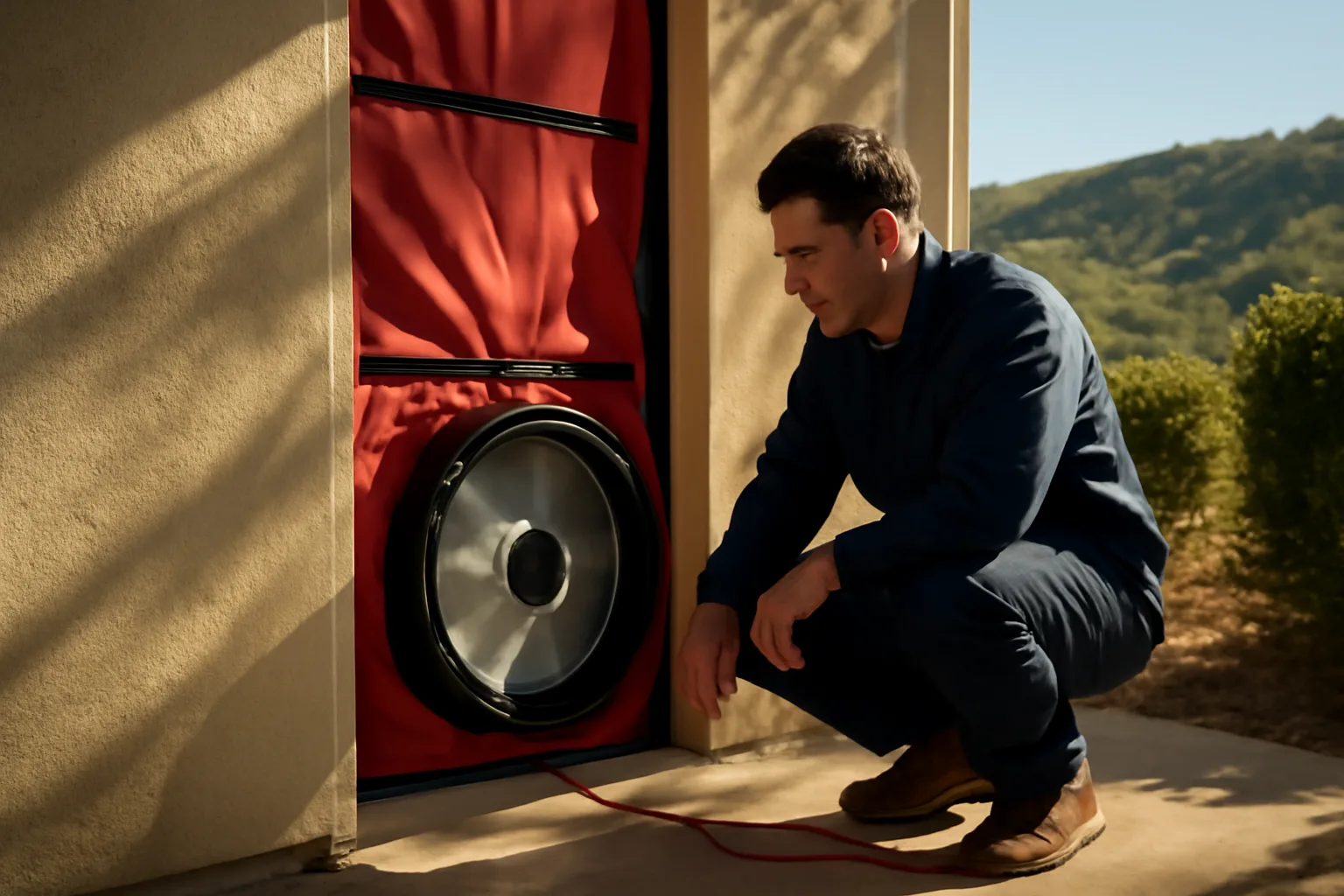
A blower door is a fan-and-frame system mounted in an exterior doorway to depressurize the house and measure air infiltration. A duct blaster pressurizes the duct system to measure leakage. Together they cover the most common HERS verification requirements in California new construction.
You'll also need a laptop running your rating software (EnergyPro for California compliance work), a digital manometer, probe attachments, and basic hand tools. Some raters add combustion safety testing gear if they work the existing-home audit market.
Equipment is the single largest variable cost in getting started. New Minneapolis Blower Door equipment from The Energy Conservatory starts around $3,000 for the basic Model 3 and climbs from there for digital gauging systems [5]. Retrotec sells competing products at similar prices. Buying quality used equipment from a rater who's upgrading or leaving the field is a legitimate move that plenty of new raters make to cut entry costs.
Calibration matters. RESNET and most providers require equipment to be within manufacturer calibration specs. Keep your calibration records.
How does California Title 24 connect to HERS certification?
California's Title 24, Part 6 is the state's building energy efficiency standard, updated on a roughly three-year cycle. The 2022 standards took effect January 1, 2023 [1]. Under Title 24, builders can show code compliance through a prescriptive path (install what the code specifies) or a performance path (model the building and prove it meets an energy budget). Both paths frequently require HERS field verification of installed systems.
Title 24 Section 10-103 requires that "compliance documentation shall be prepared by a person who has been certified to prepare compliance documentation by an approved HERS Provider" [1]. That's the statutory hook that makes HERS certification necessary for California compliance work. It is not a standalone state license.
The 2022 cycle expanded requirements for heat pump water heaters and solar-ready wiring, so raters here are seeing new verifications compared to the 2019 cycle. Keeping up with each Title 24 update is ongoing work.
The California Energy Commission publishes free Title 24 compliance manuals and reference appendices [8]. These are genuinely useful to read before training, not after.
Can a HERS rater certified in another state work in California?
Yes, because RESNET certification is national and your rater credential itself transfers. But working California compliance jobs requires affiliation with a CEC-registered Rating Provider, and you need to be current on California's compliance software and code.
In practice: if you're already certified in, say, Arizona, you affiliate with a CEC-registered provider and start California work once you're trained on EnergyPro and Title 24 specifics. That transition training is usually shorter than full initial certification, maybe a few days to a few weeks depending on how different the software is from what you've used.
Some providers actively recruit raters from other states during California construction booms, especially in markets like the Inland Empire and Central Valley where new residential development runs hot.
For comparison, see HERS rater license in Arizona to gauge what Arizona-certified raters already know going in.
What does a California HERS rater earn and how big is the market?
Salary data specific to HERS raters is thin. The Bureau of Labor Statistics doesn't break out HERS rater as its own occupation. The closest match is "Energy Auditors" under BLS SOC code 47-4011, where the 2023 national median annual wage sat in the $60,000 to $70,000 range, with California workers typically near the top of that range because of cost of living and heavy construction volume [6].
California raters work a few different ways. Many are employees of energy consulting firms or HVAC contractors who offer HERS verification as an add-on. Others go independent and bill per job. Per-rating fees vary by complexity but usually run $150 to $400 for a standard new construction verification, higher for complex projects with multiple verifications.
The market is genuinely large. California consistently ranks among the top two or three states for residential construction volume [4]. Title 24 means nearly every new home generates HERS work. The 2022 updates and the push toward building electrification are widening the scope of required verifications, not shrinking it, so demand looks stable.
Nobody has clean data on the exact number of active California HERS raters. The CEC HERS Provider Registry and RESNET's rater lookup are the best proxies, but neither publishes a tidy state-level active-rater count. If you're sizing up a specific metro, the rater search on individual provider websites usually tells you more than any national aggregate.
Weighing neighboring markets? HERS rater license in Colorado and how to start HERS rater in Colorado cover a state with similar RESNET-based certification and real new construction demand.
What are the common mistakes new California HERS raters make?
The first and most expensive mistake is picking a training provider that isn't CEC-registered, or whose registration has lapsed. Your certification is worthless for Title 24 compliance if your provider can't register ratings with the CEC. Check the CEC provider registry before you pay a training deposit [2].
The second is underbudgeting equipment. Grabbing the cheapest blower door off an auction site without checking calibration status is a false economy. Uncalibrated equipment means you can't certify your measurements, which means ratings fail quality assurance review.
Third: underestimating the supervised rating requirement. New raters sometimes think they can bill clients the day after passing the exam. You can't. You practice independently only after completing required mentored ratings. Plan for the gap financially.
Fourth: ignoring EnergyPro. If you trained in another state on REM/Rate, you need California-specific software training. REM/Rate outputs won't work for Title 24 documentation.
Fifth, and this one surprises people: not reading the actual Title 24 reference documents before starting. The CEC publishes detailed field verification and diagnostic test protocols in the Reference Appendices [8]. They tell you exactly what to measure, how, and the pass/fail thresholds. Read them once before your first field day and you'll look competent. Skip them and you'll be lost on the job.
HERSPath's start page at herspath.com/start has a checklist that walks these decisions in order, which some new raters use as a sanity check after reading a guide like this.
How do I find a CEC-registered HERS provider in California?
The California Energy Commission keeps the authoritative list. Go to the CEC's HERS section and find the current list of approved HERS Providers [2]. It includes provider names, contact information, and sometimes the areas they serve.
CHEERS (California Home Energy Efficiency Rating Services) is one of the largest and most established CEC-registered providers in the state. Others include utility-affiliated programs and independent energy consultancies. The landscape shifts, so don't trust a list that's more than a year old.
When you call a provider, ask these specific questions before you commit: Is your CEC registration current? What is your annual rater affiliation fee? Do you have active Rater Trainers in my region who can supervise my mentored ratings? What rating software do your raters use? How do you handle quality assurance reviews, and what happens if a rating gets flagged?
Those answers tell you more than any marketing page. A provider who can't answer the mentored rating question clearly is one you probably shouldn't lean on as a new rater.
Frequently asked questions
Do you need a license for HERS rater in California?
No state-issued license exists for HERS raters in California. You need RESNET certification through an accredited Rating Provider that is also registered with the California Energy Commission. That certification is what California accepts for Title 24 compliance work. Some people call this a "license" colloquially, but the formal credential is RESNET certification, not a California government license.
How much does it cost to become a HERS rater in California?
Budget $2,000 to $6,000 for the used-equipment path or $4,000 to $11,000 if you buy new gear. The main line items are training ($400 to $1,200), RESNET membership (around $125 to $200 per year), Rating Provider affiliation fees ($300 to $1,200), blower door and duct blaster equipment, and EnergyPro software ($500 to $800 per year). Confirm all current fees with RESNET and your chosen provider.
How long does it take to become a HERS rater in California?
Expect two to six months from enrollment to your first independently filed California rating. Training takes one to two weeks. The RESNET exam comes next. Then you complete a required set of supervised mentored ratings, which typically takes one to three months depending on mentor availability and local construction volume. CEC provider affiliation runs in parallel and doesn't add time if your provider is already registered.
Does California have its own HERS certification separate from RESNET?
No. California uses RESNET's national Home Energy Rating System as the basis for Title 24 compliance. The California Energy Commission approves providers (Rating Providers) who operate the RESNET system within California, but the underlying certification standard is RESNET's, not a California-specific framework. You get one RESNET certification that works nationally, then affiliate with a CEC-registered provider to do California compliance work.
What software do California HERS raters need?
EnergyPro is the dominant software for California Title 24 compliance documentation. It's required for performance compliance calculations and HERS rating registration with the CEC. Licensing runs roughly $500 to $800 per year depending on tier. Some Rating Providers supply or subsidize software access for affiliated raters. REM/Rate, common in other states, is not accepted for California Title 24 compliance documentation.
Can I do HERS ratings independently in California or do I need to work for a company?
You can work as an independent rater, but you must be affiliated with a CEC-registered Rating Provider. Your ratings get registered through that provider's system. Many independent California raters run their own businesses while maintaining a provider affiliation for administrative compliance. The provider relationship is mandatory for California compliance work even if you're otherwise self-employed.
What is the RESNET exam like and how do I pass it?
The RESNET rater exam is a standardized, proctored test covering building science, HVAC systems, duct and envelope testing, and rating software concepts. RESNET doesn't publish pass rates publicly. Candidates who complete an accredited training program typically pass on the first attempt, according to anecdotal reports from instructors. Studying the RESNET Standards document and your provider's training materials is the straightforward preparation path.
How many supervised ratings do I need before I can rate independently in California?
RESNET sets the minimum number of mentored ratings required before independent certification. The specific count is defined in RESNET's Mortgage Industry National Home Energy Rating Standards (MINHERS). Confirm the current requirement directly with RESNET or your Rating Provider, as standards can be updated between code cycles. Most new raters complete their supervised ratings over four to eight weeks if they have consistent access to a Rater Trainer.
Does California Title 24 require a HERS rater for all new homes?
Not automatically, but most new homes trigger at least one HERS field verification requirement. Under the 2022 Title 24 standards, common verification requirements include duct leakage testing, refrigerant charge verification, and airflow measurement for HVAC systems. Homes using the performance compliance path almost always require a HERS rater. Prescriptive-path homes often still require field verification for mechanical system features.
What is the CEC HERS Provider Registry and why does it matter?
The California Energy Commission HERS Provider Registry is the state's official list of organizations approved to register HERS ratings for Title 24 compliance. If your Rating Provider isn't on this list, the ratings you file won't be accepted for California building permits. Always verify your provider's CEC registration is current before signing an affiliation agreement. The CEC publishes the registry on its website.
Can I transfer my HERS certification from another state to California?
Yes, because RESNET certification is national. If you're already a certified HERS rater, your credential is valid in California. You'll need to affiliate with a CEC-registered Rating Provider, complete any California-specific software training (particularly EnergyPro), and be current with 2022 Title 24 requirements. Most experienced out-of-state raters complete this transition in a few weeks, not months.
How often do I need to renew my HERS rater certification in California?
RESNET requires annual membership renewal and periodic continuing education. The specific continuing education hours required and the renewal process are defined in RESNET's standards and updated periodically. Your Rating Provider handles much of the administrative renewal coordination. California's Title 24 updates every three years, and providers typically require raters to complete code-update training when a new cycle takes effect.
Is HERS rater work in California a viable full-time career?
It can be. California's volume of new residential construction is one of the highest in the country, and Title 24 compliance requirements generate consistent rater demand. Most full-time raters either work for energy consulting firms or run independent businesses serving HVAC contractors and builders. Income varies widely by region and client base. Central Valley and Inland Empire markets tend to have higher permit volumes; coastal metros have higher per-job fees.
What's the difference between a HERS rater and a home energy auditor in California?
A HERS rater is specifically trained and certified to produce RESNET Home Energy Ratings and to perform Title 24 field verifications for new construction compliance. A home energy auditor is a broader term that can include Building Performance Institute (BPI) certified auditors who focus on existing homes and utility rebate programs. Some practitioners hold both credentials. For California new construction compliance work, HERS certification is what matters.
Sources
- California Energy Commission, 2022 Building Energy Efficiency Standards (Title 24, Part 6): Title 24 Part 6 requires HERS field verification by a certified rater for new construction compliance; the 2022 standards took effect January 1, 2023
- California Energy Commission, HERS Program and Provider Registry: The CEC maintains the official registry of HERS Providers authorized to register ratings for Title 24 compliance in California
- RESNET, Residential Energy Services Network: RESNET accredits Rating Providers, sets rater training and exam requirements, and maintains the national rater certification database
- U.S. Census Bureau, New Residential Construction, Building Permits Survey 2023: California issued approximately 100,000 residential building permits in 2023, making it one of the highest-volume states for new residential construction
- The Energy Conservatory, Minneapolis Blower Door Products and Pricing: New Minneapolis Blower Door equipment starts around $3,000 for the basic Model 3 configuration, with higher prices for digital gauging systems
- U.S. Bureau of Labor Statistics, Occupational Employment and Wage Statistics, Energy Auditors (SOC 47-4011), May 2023: National median annual wage for energy auditors was in the $60,000 to $70,000 range in 2023, with California workers typically near the higher end
- RESNET, Mortgage Industry National Home Energy Rating Standards (MINHERS): RESNET MINHERS defines the minimum number of supervised mentored ratings required before a new rater can certify independently
- California Energy Commission, 2022 Residential Compliance Manual and Reference Appendices: The CEC publishes free compliance manuals and Reference Appendices detailing field verification and diagnostic test protocols, including pass/fail thresholds for HERS measures